 blog
Industrial Fabrication and Repair Services: 2026 Guide
Table of Contents
- What Industrial Fabrication and Repair Services Cover
- Custom Steel Fabrication for Industrial Facilities
- Industrial Equipment Repair Services: What to Expect On Site
- Building an Industrial Fabrication Project Scope Checklist
- Industrial Fabrication Safety Standards and Code Compliance
- How to Choose an Industrial Fabrication and Repair Partner
- Frequently Asked Questions
Last Updated: October 18, 2026
What Industrial Fabrication and Repair Services Cover
Industrial fabrication and repair services are the engineering, cutting, welding, machining, and on-site repair work that keeps production equipment running and facility structures sound. At Custom Construction Services LLC, we understand the value of a single provider that handles both new fabrication and breakdown repair to shorten downtime and remove the finger-pointing between trades.
That combination matters more than most buyers expect. A fabricator who has never stood on your floor during a line stoppage will design a guard or platform that fights you during installation, and a repair crew with no fabrication shop behind it will wait days for a replacement part.
Below, we break down what these services include, how to build a project scope, and what to ask before you sign.
Fabrication Capabilities: Shearing, Forming, Welding, and Machining
Shearing cuts plate and sheet to size with a straight, clean edge, producing blanks for brackets, base plates, and structural members. Forming bends that material into channels, angles, and custom profiles on a press brake.
Welding joins the assembly, and process choice matters: structural steel typically calls for shielded metal arc or flux-cored welding, while thinner sheet and stainless often suit MIG or TIG.
A capable shop runs all four under one roof. When they sit in separate buildings, tolerance stack-up errors appear at assembly and you pay for the rework.
Repair and Field Service Work
Repair covers the equipment itself: gearboxes, power transmission components, shafts, housings, and structural supports that have cracked or worn. Field services move that work to your floor when the machine cannot be moved, common for large machinery tied into a production line.
Mobile welding and on-site machining let crews correct a worn shaft journal or weld a cracked frame in place.
Custom Steel Fabrication for Industrial Facilities
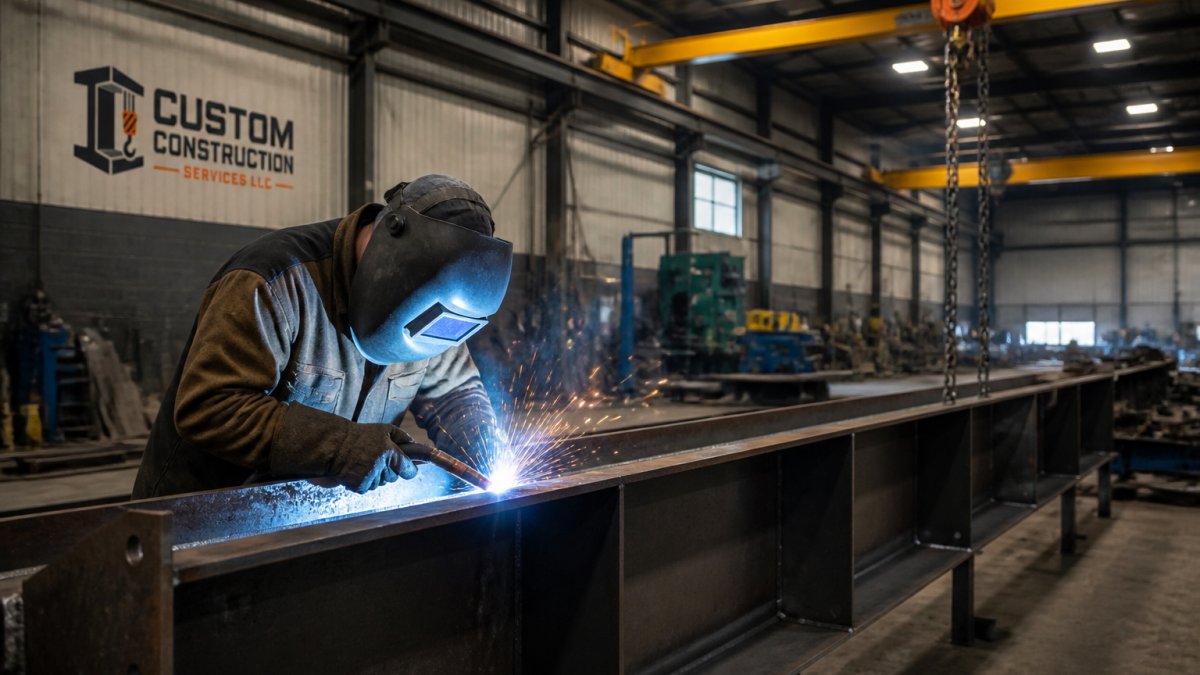
We treat three details as non-negotiable on custom steel work:
- Connection design. Bolted connections get specified so components can be disassembled later for equipment swaps. Welded connections are stronger but permanent.
- Coating system. Wash-down areas and food-adjacent spaces need different protection than a dry warehouse.
- Tolerance plan. Shop tolerances and field tolerances are different things. State both before fabrication starts.
Custom fabrication is a measurement discipline before it is a welding discipline. A shop that verifies dimensions and elevation before cutting steel avoids the most expensive category of rework.
Industrial Equipment Repair Services: What to Expect On Site
Industrial equipment repair services typically follow four stages: assessment, disassembly and inspection, repair or replacement, and realignment and testing. The assessment stage separates good providers, because a proper inspection documents wear patterns and identifies root cause rather than just the failed part.
Expect the crew to arrive with load-rated rigging, lockout/tagout procedures in hand, and a written sequence for the work, plus a plan for components that turn out worse than expected once opened.
Repair Versus Replace: A Decision Framework
The hardest call on a repair ticket is whether to fix the component or replace the asset. Most practitioners work through four questions before committing:
- Failure mode. Is the wear predictable and isolated (a worn bearing, a scored shaft journal) or systemic (fatigue cracking across a housing, repeated misalignment)? Isolated wear favors repair; systemic failure favors replacement.
- Remaining structural margin. Measure wall thickness, shaft diameter, and weld throat against the original specification. Once a load-bearing member has lost a meaningful share of its section, repair restores geometry but not the original safety factor.
- Repeat history. A component that has failed twice in the same location is telling you the root cause was never corrected. Repairing it a third time is a schedule risk, not a savings.
- Production criticality. If the asset sits on the only line that makes a product, the downtime exposure of a second failure usually outweighs the cost difference between repair and replacement.
Document the answers in writing. That record defends the decision to ownership and your insurer and turns a reactive repair into a planned capital decision.
Preventive Maintenance Planning
Treating repair as emergency-only is a common mistake. Plants that schedule preventive inspections on gearboxes, power transmission equipment, and structural supports catch failures before they stop a line. A practical program covers three cadences:
- Monthly walkdowns for visible signs: oil weeping at seals, loose anchor bolts, cracked welds at support brackets, guard damage.
- Quarterly vibration and alignment checks on rotating equipment, which catch bearing degradation and coupling wear long before a failure.
- Annual structural inspections of platforms, mezzanines, crane rails, and equipment skids, including coating condition in wash-down and food-adjacent areas.
Field Service Constraints Buyers Should Plan For
Mobile welding and on-site machining let crews correct a worn shaft journal or weld a cracked frame in place, avoiding rigging and transport but demanding cleaner access, better ventilation, and tighter planning around your production schedule. Confirm before mobilization that the provider has hot-work permitting under the local fire authority, confined-space procedures where applicable, and a ventilation plan for enclosed plant areas.
Building an Industrial Fabrication Project Scope Checklist
An industrial fabrication project scope checklist defines the work, standards, schedule, and acceptance criteria before fabrication begins. Without one, change orders accumulate and nobody can prove what was agreed.
Use this checklist on your next project:
- Field measurements and elevations verified and signed off
- Drawings stamped and approved, with revision numbers controlled
- Material specifications listed by grade and thickness
- Welding procedures and inspection requirements defined
Each line protects both sides. The shutdown window item, for instance, forces the production-calendar conversation early, when the schedule can still absorb it.
| Scope Element | Why It Matters | Who Owns It |
|---|---|---|
| Field verification | Prevents fit-up rework | Fabricator |
| Stamped drawings | Confirms code compliance | Engineer of record |
| Material grade | Governs strength and weldability | Fabricator and owner |
| Coating system | Determines service life | Owner with fabricator input |
| Shutdown window | Protects production uptime | Owner |
| Acceptance criteria | Defines "done" | Both parties |
What Drives Fabrication Cost
Pricing is not visible in most quotes until the scope is fixed, but the factors that move the number are predictable. Understanding them lets you compare bids on equal footing.
- Material grade and thickness. Higher-strength steel and heavier plate raise both material and welding cost, and thick sections may require preheat and post-weld treatment.
- Tolerance class. Tight machining tolerances and flatness requirements add shop time and inspection steps. State the tolerance you actually need, not the tightest one available.
- Welding procedure and inspection level. Full penetration welds with ultrasonic or radiographic inspection cost more than visual-only fillet welds. Match inspection to the structural role of the joint.
- Coating system. A standard shop primer is a different cost tier from a multi-coat system for wash-down or corrosive service.
- Site conditions. Access, rigging, crane reach, and shutdown windows drive installation cost as much as fabrication cost. A platform that can be assembled on the ground and lifted into place is cheaper to install than one built in the air.
What to Send for an Accurate Quote
Quote quality tracks the quality of the information you send, because a provider can only price what is documented. Prepare a package that includes:
- Drawings or sketches with dimensions, elevations, and connection intent, even if hand-marked.
- Field measurements of the actual as-built condition, including slab slope, obstructions, and anchor locations.
- Material specification by grade and thickness, or the performance requirement if the grade is open.
- Service environment so the coating system can be specified correctly.
- Site access details: door widths, ceiling heights, crane availability, and any rigging restrictions.
A provider who asks for this package before quoting intends to build to it. One who quotes from a phone description is pricing a guess, and change orders will follow.
Industrial Fabrication Safety Standards and Code Compliance
Industrial fabrication safety standards center on OSHA requirements for welding, cutting, and brazed work, plus structural code compliance through the International Building Code and AISC steel construction standards.
The OSHA welding, cutting, and brazing standards set requirements for ventilation, fire prevention, protective equipment, and confined space entry. For structural work, the American Institute of Steel Construction specification governs fabrication and erection tolerances.
Local considerations add a layer.
Code compliance is a design and documentation obligation, not a final inspection hurdle. Certified welding procedures, traceable material certifications, and stamped drawings are what let a project clear inspection the first time.
How to Choose an Industrial Fabrication and Repair Partner
Choose a partner on four criteria: documented fabrication capability, field service depth, safety and insurance standing, and communication discipline. Everything else is secondary, including price.
Here is where we would push hardest during your evaluation:
- Ask for the shop capability list. Shearing, forming, welding, and machining should all be in-house. If a provider subcontracts the machining, tolerances get negotiated between two companies instead of controlled by one.
- Confirm insurance and bonding. A certificate of insurance naming your facility should be standard, along with a bonding capacity that matches the project size.
- Name the point of contact. Ask who your single contact is and how often you will hear from them. Contractors who go quiet mid-project cost more than their bid difference.
- Test the schedule commitment. Ask how they handle a hard production deadline and what their recovery plan looks like if a delivery slips.
- Check multi-site capacity. If you operate across several facilities in the region, confirm the provider can staff more than one site at a time.
Custom Construction Services LLC brings hands-on project management from planning through completion, with experience across both commercial and industrial environments, including machine moving, equipment installation, concrete work, and facility improvements.
Production downtime is the real cost of a poorly managed fabrication or repair project, and it compounds every day a crew waits on parts, drawings, or answers.
Frequently Asked Questions
What do industrial fabrication and repair services include?
Industrial fabrication and repair services cover metal fabrication (shearing, forming, welding, and machining), custom steel fabrication for structural and equipment components, on-site and shop-based equipment repair, and field services such as machine relocation and installation support. A full-scope provider also handles engineering and design review, project management, and coordination with concrete and foundation work so fabricated components fit the facility as built. For commercial and industrial facilities, the work is typically tied to production uptime, so scheduling and turnaround time matter as much as the fabrication itself.
What safety considerations apply to industrial equipment repair?
Industrial fabrication safety standards center on lockout/tagout before any equipment is opened, hot-work permits and fire watch for welding and cutting, confined space procedures where applicable, and proper rigging plans for heavy lifts. Contractors should carry current insurance and provide documentation before mobilization. In Wisconsin and Illinois facilities, work also needs to align with local building code requirements and any owner-specific plant safety rules. Ask for the written safety plan and confirm who supervises hot work before repair crews arrive on site.
What information should I provide for an industrial fabrication estimate?
Bring drawings or sketches with dimensions, material specifications, quantity, tolerances, and the required delivery or install date. Note site access constraints, overhead clearance, floor loading limits, and whether the work is shop-fabricated or field-erected. Photos of the existing condition help. A clear industrial fabrication project scope checklist reduces change orders later. Pricing depends on material, complexity, and schedule, so request a written quote rather than a verbal range, and confirm what is included for delivery, installation, and inspection.
When should industrial equipment be repaired or replaced?
Repair usually wins when the failure is isolated, parts are available, and the equipment still meets production requirements. Replacement becomes the better decision when repairs recur, the component is obsolete, or downtime costs from repeated failures exceed the cost of new equipment. Get a written assessment covering repair scope, expected service life after repair, and lead time for replacement. A contractor who handles both industrial equipment repair services and custom fabrication can often recommend a repair that restores function without a full replacement, which keeps production running.